TM0415 · World's First Methane-Free Feed Technology

Challenging the world's first methane-free feed technology.

TM0415 is being developed as an amorphous iron-sulfur cluster (NANO AISC) feed additive — aiming for near-total enteric methane elimination while supporting productivity gains. In vitro results and KALRO Kenya reference data shown below; definitive US in vivo trials begin November 2026.

96.1% Methane reduction (in vitro)
1.2ppm Catalytic effective dose
2× Productivity uplift (Kenya reference)

* Based on our own in vitro experimental results — to be used as reference-level data only until US in vivo trials are complete.

Electron intercepted
96.1% CH₄ blocked
2× milk yield
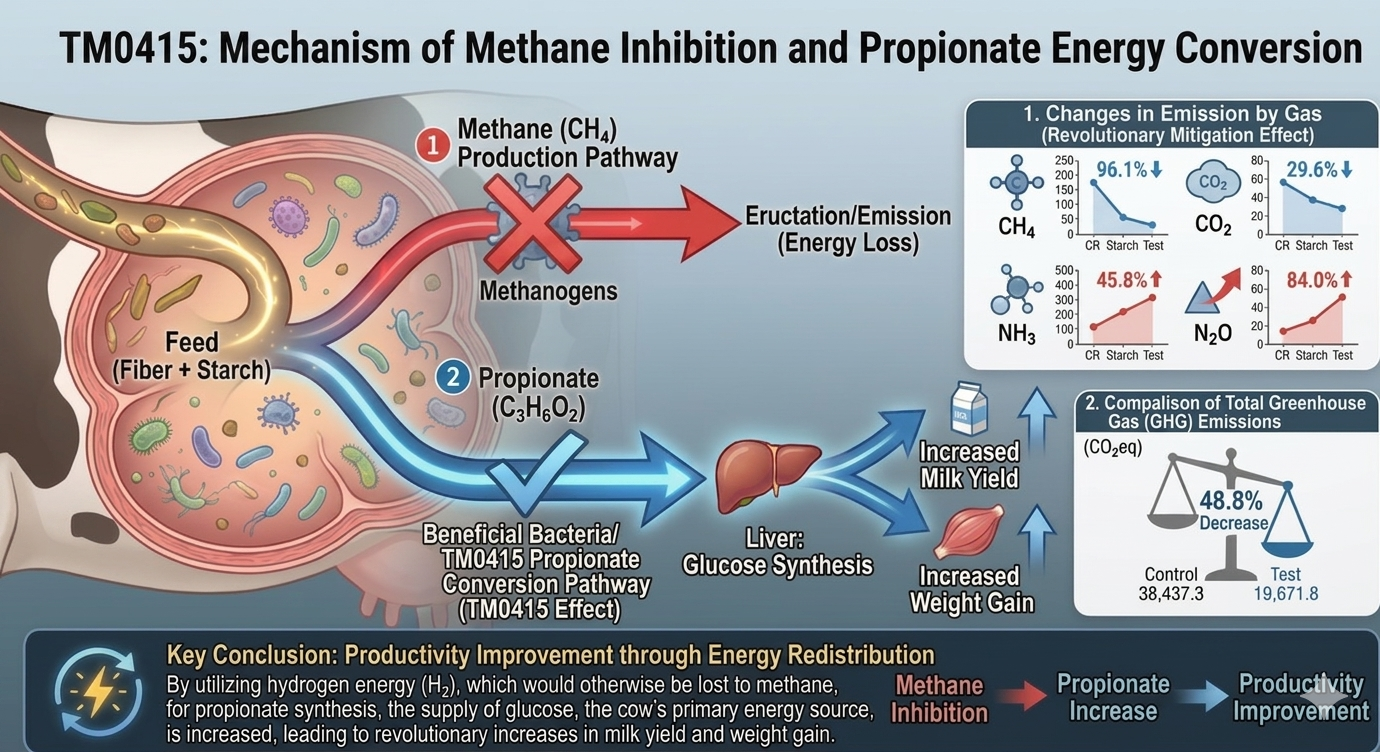
In vitro gas generation measurement results — 96.1% methane reduction, 48.8% total greenhouse gas reduction
In vitro gas measurement — controlled rumen-fluid testing showed up to 96.1% CH₄ reduction and 48.8% total greenhouse gas reduction (CO₂eq basis). Our own in vitro experimental results — reference-level data only, to be used until US in vivo trials are complete.
×80
Methane's 20-year warming power vs CO₂. The fastest climate lever on Earth.
12 yr
Atmospheric lifetime — cut methane today, see cooling within a decade.
30%
Of global anthropogenic methane comes from agriculture. Mostly cattle.
150+
Countries pledged to cut methane 30% by 2030 (Global Methane Pledge).
The Industry Crunch

Scope 3 just became the C-suite's biggest problem.

90–95% of a global food brand's carbon footprint sits inside the supply chain — on dairy and beef farms they don't own. They've made public Net-Zero promises. The clock is ticking. And until now, no solution made the math work for the farmer.

Starbucks
22% of footprint = milk

Latte and frappuccino dairy outweighs coffee beans as the single largest emission source.

McDonald's
80% supply chain, beef-dominant

The world's largest beef buyer. Net-Zero target physically impossible without methane mitigation.

Nestlé · Danone
M+dairy partner farms

Public 2050 Net-Zero commitments. Tens of millions of cows in scope. No alternative on the market.

⚖️
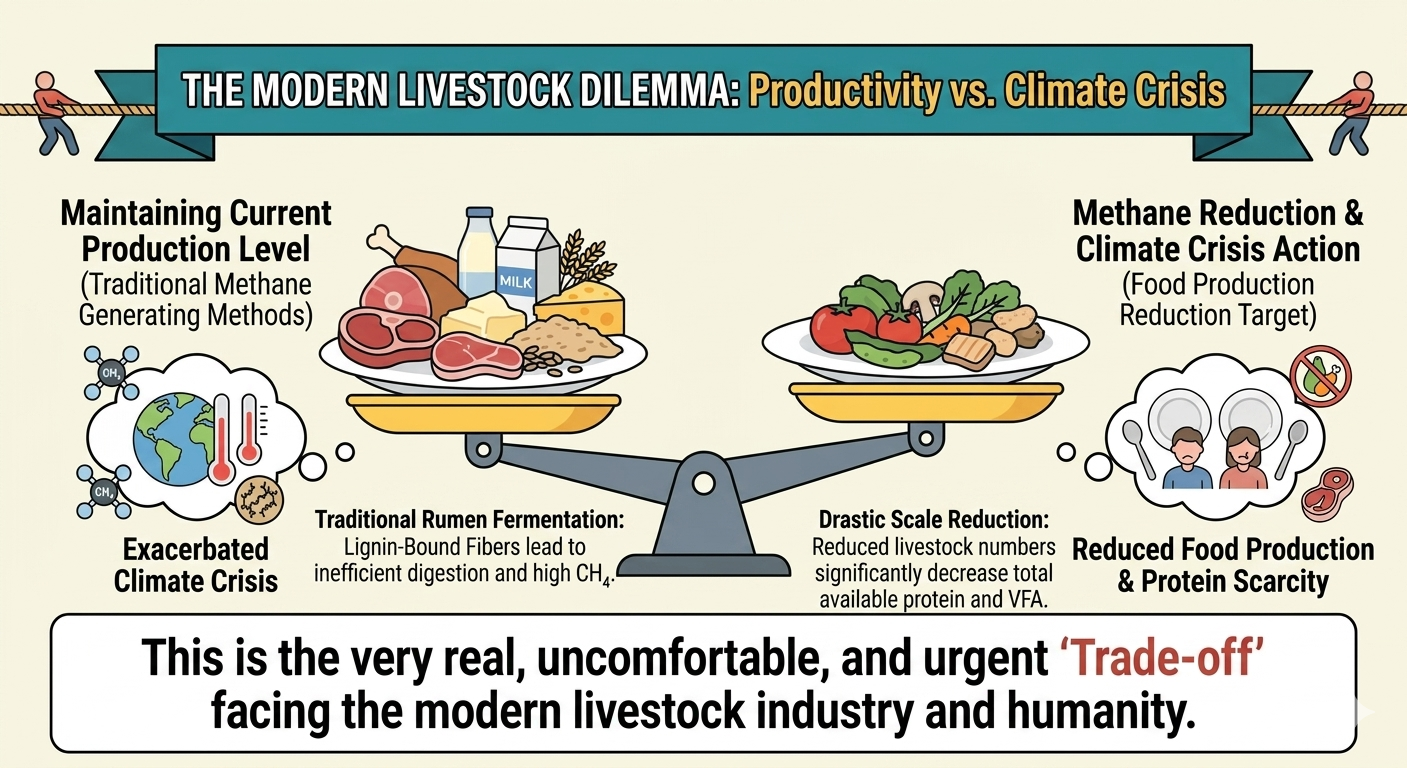
Maintaining production means more methane.
Cutting methane has meant lower productivity.
TM0415 was built to break this trade-off — for the first time.
The modern livestock dilemma — a scale balancing production levels against methane and climate action
The trade-off, visualized — production vs climate is the fundamental tension TM0415 dissolves.
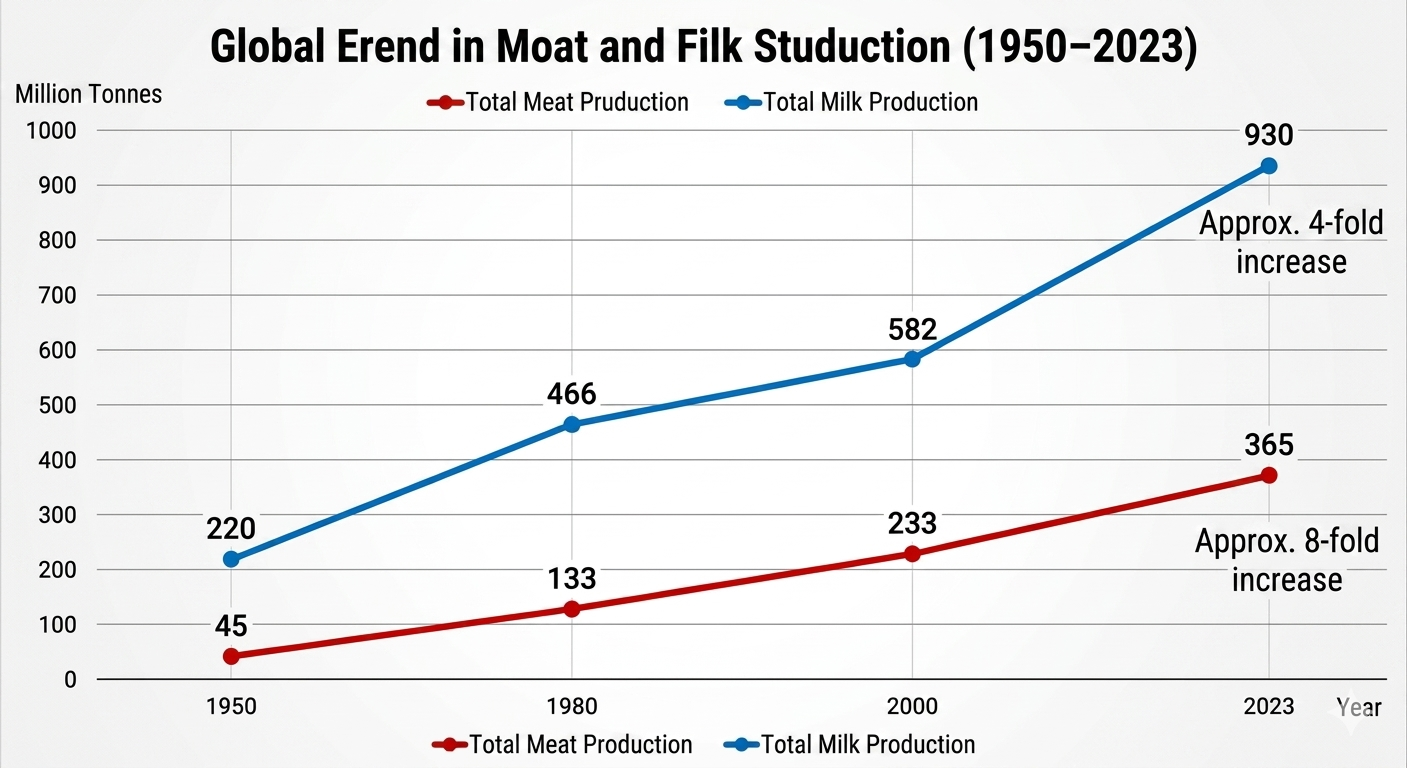
Global trend in meat and milk production 1950-2023
70 years of exponential demand — meat production rose 8× while population only tripled. Methane scaled with it.
The Root Cause

The cow doesn't want to belch methane.
It has nowhere else to put the hydrogen.

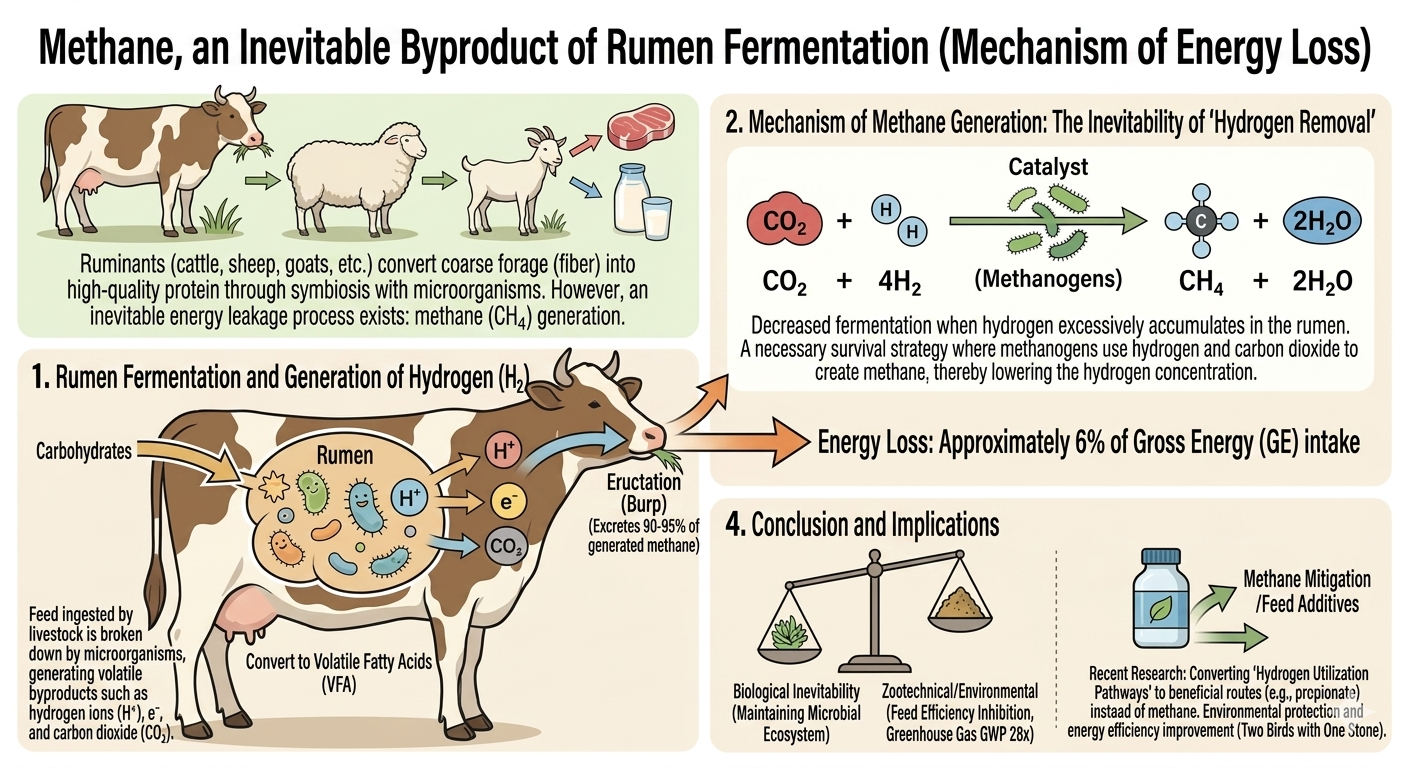
Rumen fermentation generates enormous amounts of hydrogen as a metabolic byproduct. If it accumulates, microbial metabolism stalls and the cow's digestion collapses. Methanogens "save the system" by combining H₂ with CO₂ to form methane — exhaled as eructation. The cost: 6–12% of total ingested energy, lost as greenhouse gas.

14.5%
Share of global anthropogenic greenhouse gas from livestock (FAO)
28×
100-year warming potential of CH₄ vs CO₂ (IPCC GWP100)
250–500L
Methane belched per cow per day (EPA)
6–12%
Of feed gross energy vented to atmosphere as CH₄
Rumen fermentation byproduct methane — mechanism of energy loss
Rumen fermentation — where dietary energy leaks out as CH₄
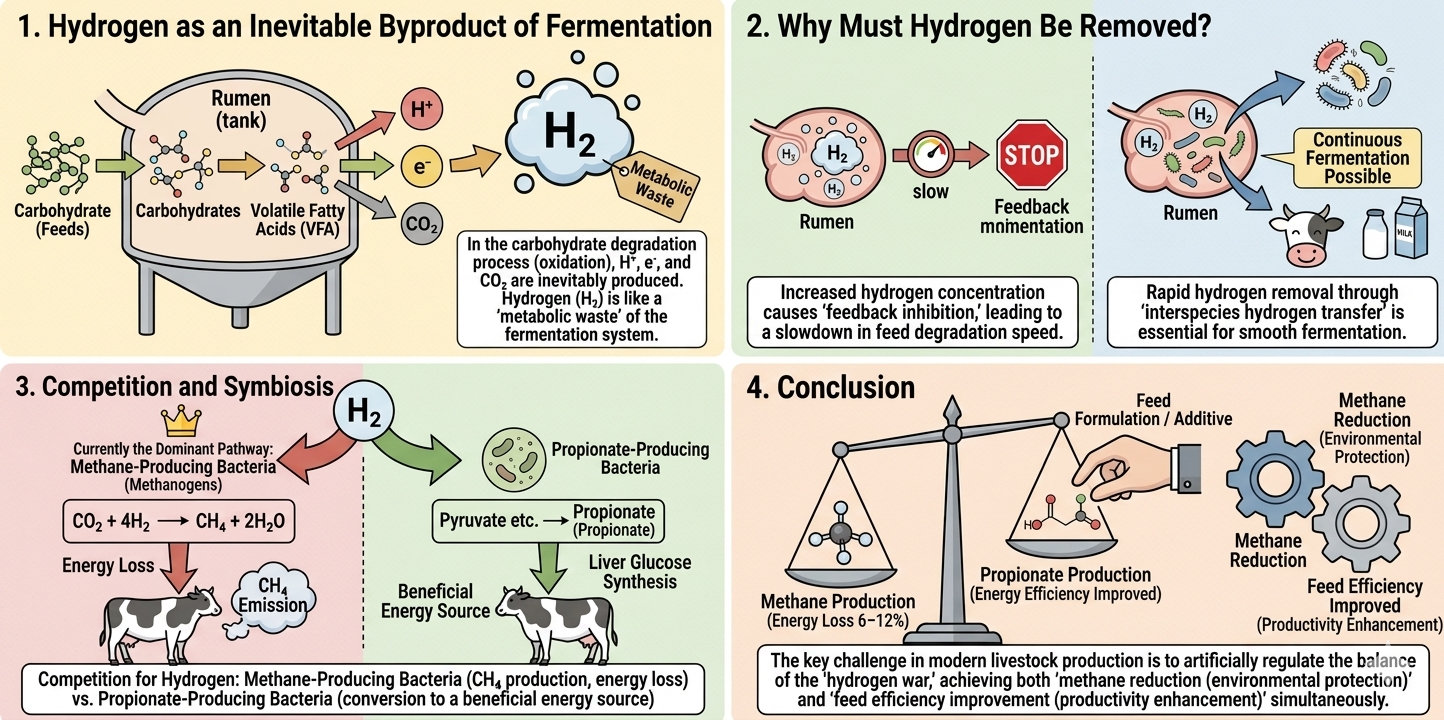
The hydrogen war in the rumen — roles and competition among microorganisms
The "Hydrogen War" — methanogens, propionate-producers, and other microbes all compete for surplus H₂. Whoever wins decides whether energy becomes methane or productivity.
Core Technology

TM0415: A nano-engineered amorphous iron-sulfur cluster.

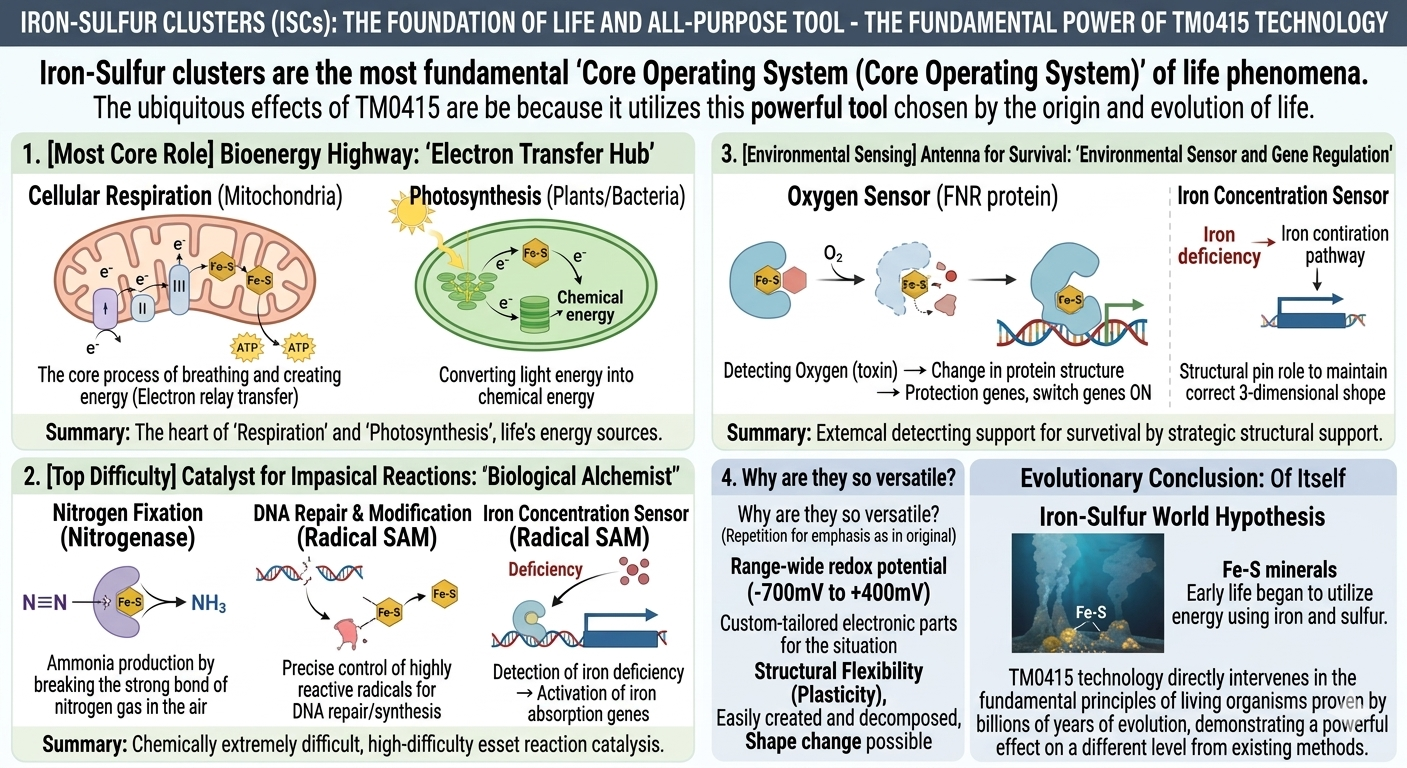
Iron-sulfur clusters are nature's universal electron-transfer machinery — operating in every living mitochondrion, every photosynthetic cell, every nitrogen-fixing organism on Earth. We've engineered them to do something they never could before: survive outside a cell.

⟶ NANO

Nano-scale geometry

Particle-scale control gives massive surface-to-volume ratio — every gram exposes vast active sites that can capture electrons at the rate microbes release them. Reaction kinetics on a different dimension from conventional additives.

⟶ AMORPHOUS

Disordered & defect-rich

Unlike rigid crystalline clusters, TM0415 is a non-uniform Fe–S lattice riddled with intentional defects. These structural irregularities function as infinite electron-acceptor sites — a true electron sponge.

⟶ STABILIZED

The breakthrough nobody else cracked

A proprietary matrix shields the cluster core from oxygen, light, and aqueous oxidation — yet remains permeable to hydrogen and electrons inside the rumen. Stable in storage. Explosive in vivo.

The paradox solved: Fully stable ex vivo × powerfully reactive in vivo — the world's only iron-sulfur technology to engineer this contradiction. Effective at 1.2 ppm iron content. GLP acute oral toxicity >5,000 mg/kg · GLP 13-week repeated-dose oral toxicity >1,000 mg/kg — both exceeding the toxicology test limit dose (Non-toxic per EPA criteria).
Iron-sulfur clusters as the foundation of life — the core operating system of biological energy
Life's Core Operating System — every breath, every photosynthesis, every cell wall in nature runs on iron-sulfur chemistry. We engineered it to work outside cells.
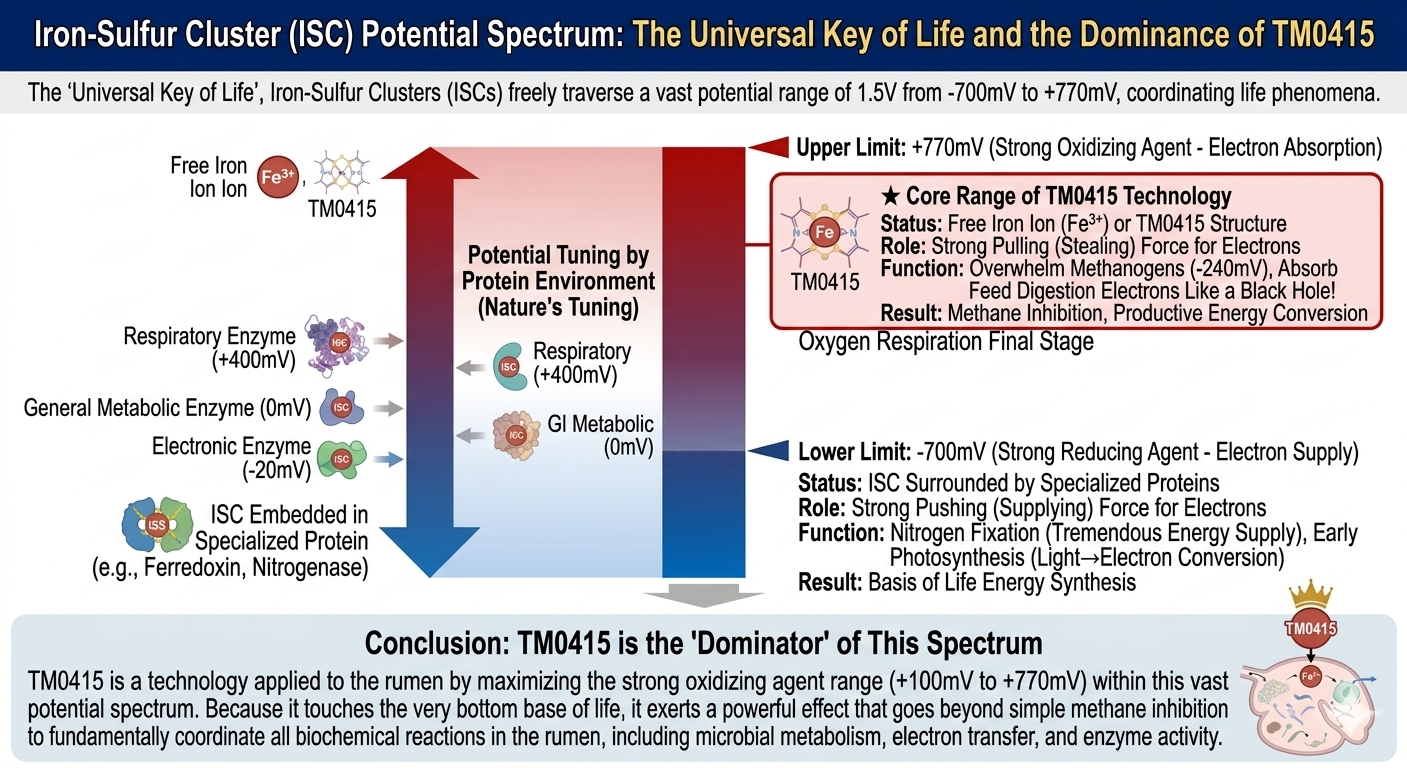
Iron-sulfur cluster potential spectrum — dominance of TM0415 across 1.1V range
1.1V dominance — TM0415's variable redox potential may span the ISC range from −700 mV (donor) to +400 mV (acceptor), tunable by electron and pH environment. May act as one of the strongest electron sinks observed in ruminant biology.
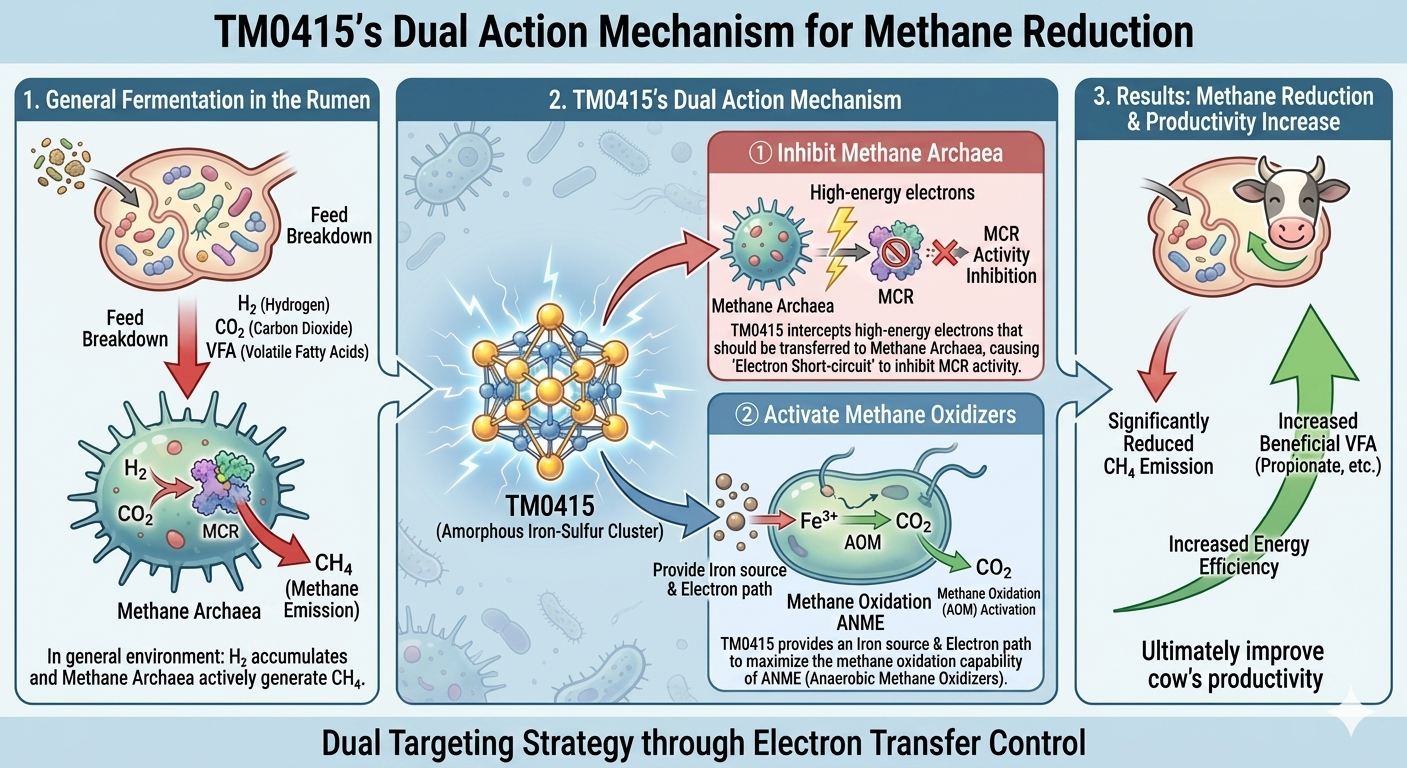
TM0415's dual-action mechanism for methane reduction — inhibit methane generation, activate productive pathways
How It Works

The Electron Short-Circuit.

Conventional inhibitors block the methane enzyme — and trap surplus hydrogen, which then ferments to lactic acid and triggers acidosis. TM0415 does the opposite: it intercepts the electrons before they ever reach the enzyme, and reroutes them into productive energy.

01

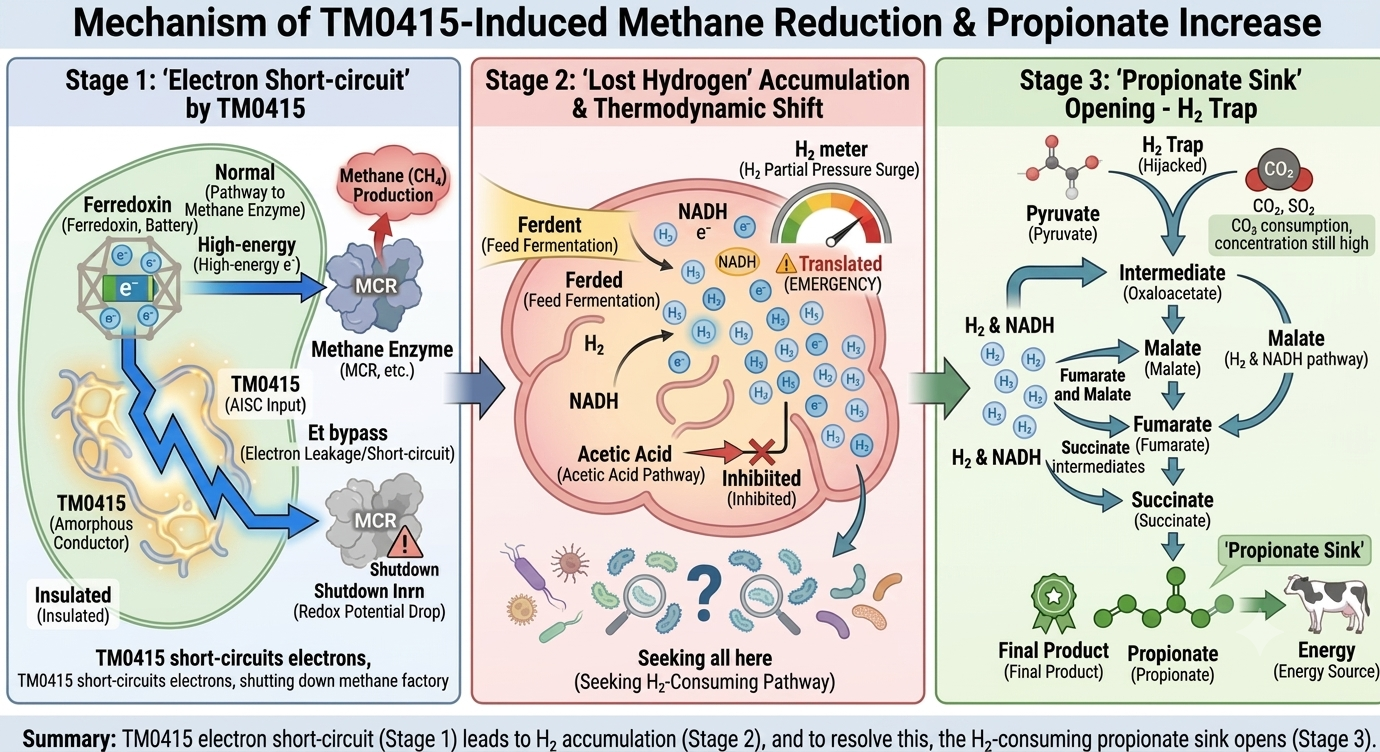
Electron short-circuit by TM0415

The high redox potential of TM0415 (variable from −700 to +400 mV depending on electron and pH environment) may pull high-energy electrons away from the ferredoxin pathway before they reach the methanogen's MCR enzyme (operating at −240 mV). The methane factory may shut down.

02

H₂ pressure shifts the thermodynamics

With methanogenesis blocked, H₂ partial pressure changes the equilibrium of microbial metabolism. The system seeks a new electron sink — and the propionate pathway is thermodynamically favored.

03

Propionate sink opens — energy is recovered

Captured electrons flow into propionate-producing bacteria. Propionate is absorbed and converted in the liver to glucose — fueling milk synthesis and weight gain. Methane energy becomes productive energy.

TM0415-induced methane reduction and propionate increase — 3-stage mechanism detail
Stage 1 → 2 → 3 in detail — electron short-circuit cascades through hydrogen accumulation into the propionate sink. The methane factory shuts down; the energy factory opens.
Speed & Dose

Electrochemical speed, catalytic-level dose.

Because TM0415 works through pure redox potential — not enzyme binding, not microbial inhibition — it activates the moment it touches rumen fluid, at concentrations so small they leave feed formulation untouched.

1.2ppm
Effective concentration
A true catalytic dose. Blends transparently into standard TMF feed with no reformulation, no palatability impact, no nutritional trade-off.
<1min
Reaction onset
Physicochemical electron capture begins the instant TM0415 dissolves. Biological inhibitors lag from 15 minutes up to several hours.
80%+
Peak-window capture
During the 1–4 hour post-feeding methane peak, TM0415 intercepts most hydrogen before methanogens can reach it — the CH₄ curve never forms.

Why 1.2 ppm beats 2% — single-use reactant vs infinite catalyst

Nitrate (NO₃⁻) · stoichiometric

~2–3% of feed mass

Each nitrate molecule binds H₂ once, becomes ammonium, is consumed. Reducing the millions of liters of H₂ generated daily requires physically pouring in proportional mass — at the cost of toxic nitrite intermediates.

TM0415 · catalytic

0.01% (~1.2 ppm Fe)

Each Fe site captures an electron, hands it to pyruvate, returns to neutral state — and does it again. A single nano-cluster cycles hundreds of thousands of times per second. 200× less material, 3× more reduction.

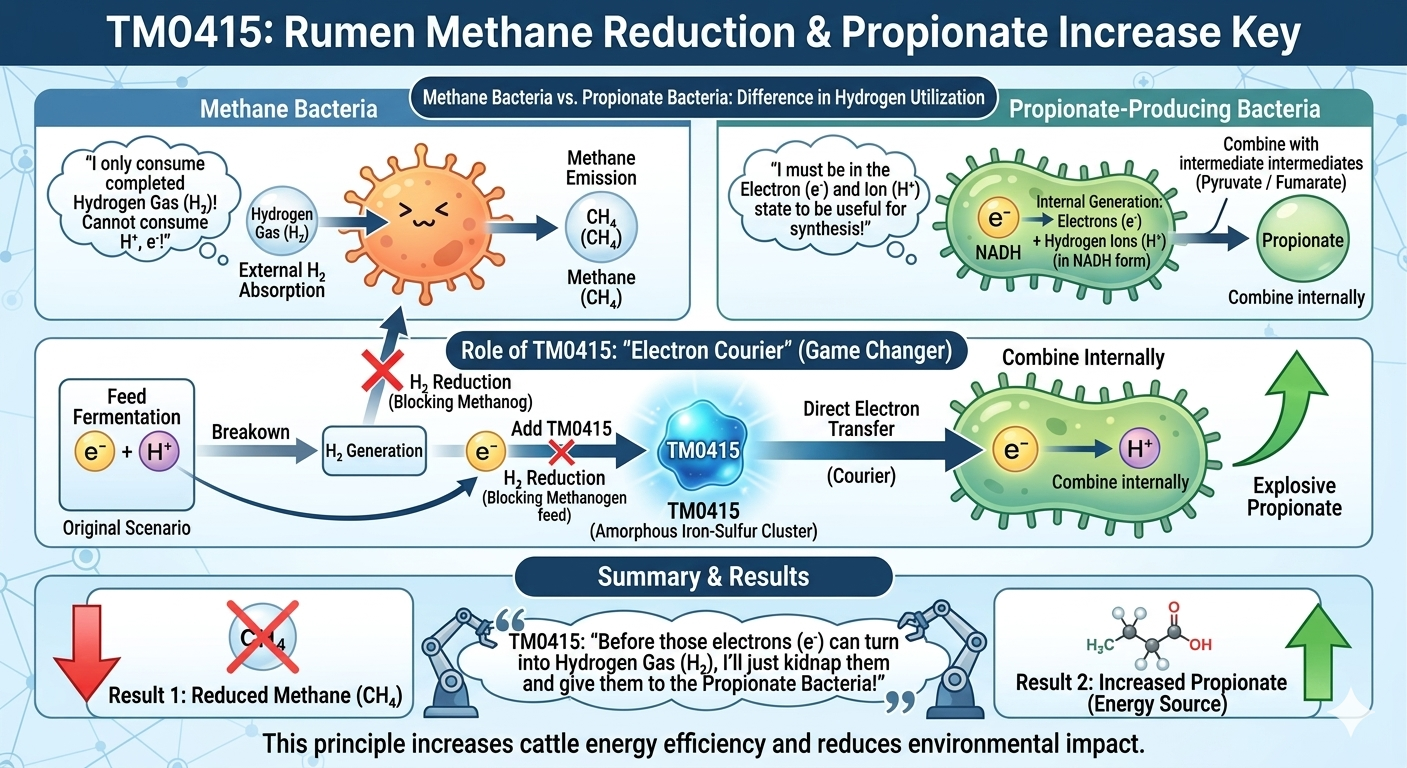
TM0415 as the key to rumen methane reduction and propionate increase
The "courier" of electrons — TM0415 doesn't compete with rumen biology; it acts as the intermediary that hands every electron to the propionate pathway instead of methanogenesis.
Compared

Every existing approach has a fatal flaw.

Chemical electron-sink approaches (nitrate, sulfate) and natural plant/oil extracts each have well-documented failure modes — low efficacy or toxic side reactions. TM0415 may be the only approach that opens an alternative pathway for the orphaned electrons, avoiding both ceilings.

Nitrate (NO₃⁻)
Chemical e⁻ sink
Sulfate (SO₄²⁻)
Chemical e⁻ sink
Plant / Oil extracts
Tannin · saponin · essential oils
TM0415
Electron short-circuit (variable-potential catalyst)
Reduction rate 20–30% 10–20% 10–20% ~96.1% (in vitro)
Mechanism Fixed-potential reactant — consumed in reaction Fixed-potential reactant — consumed in reaction Antimicrobial / metabolic inhibition Variable-potential catalyst — reroutes electrons to propionate without being consumed
Hydrogen fate Toxic intermediate (NO₂⁻) Toxic intermediate (H₂S) Accumulates — fermentation suppressed Channelled to propionate → ATP
Toxic byproducts Nitrite → methemoglobinemia → asphyxia H₂S → PEM (neural death) Indigestion, palatability loss None — non-toxic verified (GLP)
Dose ceiling Strict — more dose, more toxicity Strict — more dose, more toxicity Limited by digestion impact None — more dose intensifies effect, not harm
Recyclable in vivo No — single-use, excreted No — single-use, excreted No Yes — cluster cycles indefinitely
Effective dose 2–3% of feed mass 1–3% of feed mass Variable, often %-scale 1.2 ppm (catalytic-level)
Animal productivity Loss Loss Variable / mild loss May increase (Kenya reference data)
Scalability Industrial Industrial Agricultural sourcing limits Inorganic synthesis, ton-scale
Field-Validated

Real cows. Real farms. Independent verification.

TM0415-based TMF feed was deployed in Kenya through a KOICA technology-transfer program and evaluated by the Kenya Agricultural & Livestock Research Organization (KALRO). The cooperative-level trials may corroborate the in vitro data — at scale, on working farms. Reference-level data only; definitive validation pending US-based in vivo trials.

🇰🇪

KALRO Beef Research Institute · Lanet, Nakuru

Comparative evaluation of Total Mixed Fermentation (TMF), Total Mixed Ration (TMR), and conventional grazing on dairy cows, beef cattle, and Red Maasai sheep — including cooperative-level trials in Nakuru and Nyandarua. Conducted under the Korea–Kenya TMF Technology Transfer & Sustainable Dairy Development project (2024–2026, KOICA No. 2025-00888).

Holstein-Friesian dairy · daily milk yield

TMF (ours)
15.06 L
TMR
12.42 L
↑ +21% vs TMR · feed intake also higher (19.84 vs 18.40 kg)

Crossbred dairy · daily milk yield

TMF (ours)
6.93 L
TMR
6.51 L
Grazing
2.76 L
↑ 2.5× vs conventional grazing baseline

Beef cattle · total weight gain (45 days)

TMF (ours)
82.75 kg
TMR
52 kg
Grazing
-2.75 kg
↑ +59% vs TMR · ADG sustained at 1.31 kg/day

Red Maasai sheep · 45-day trial

TMF (ours)
8.73 kg
TMR
6.8 kg
↑ 139 g/day ADG — highest of all treatments

Then they took it to the farms.

Cooperative-level deployments in Nakuru and Nyandarua under farmer-managed conditions reproduced — and exceeded — the controlled-trial results. Three independent farms; three independent doublings.

Cost matters as much as yield. TMF unit feed price came in at KES 23/kg vs KES 39/kg for TMR — a structural cost advantage of 35–40% per kilogram, compounding the productivity gains.

11→22 L/day
Nderitu Farm · doubling of milk output within 14 days of TMF intro
11→22.5 L/day
Nuru Farm · doubled milk with lower total feed consumed
18→32 L/day
Kirikas Enterprise Farm · +70% milk yield at peak inclusion
35–40%
Feed cost reduction vs TMR — better economics, better outcomes
Source: Report on Comparative Evaluation of Total Mixed Fermentation (TMF), Total Mixed Ration (TMR), and Conventional Grazing Systems on Dairy, Beef, and Sheep Performance in Kenya — including Cooperative-Level Trials in Nakuru and Nyandarua, Kenya Agricultural & Livestock Research Organization (KALRO), Beef Research Institute Headquarters, 16 February 2026. Conducted under KOICA Project No. 2025-00888.
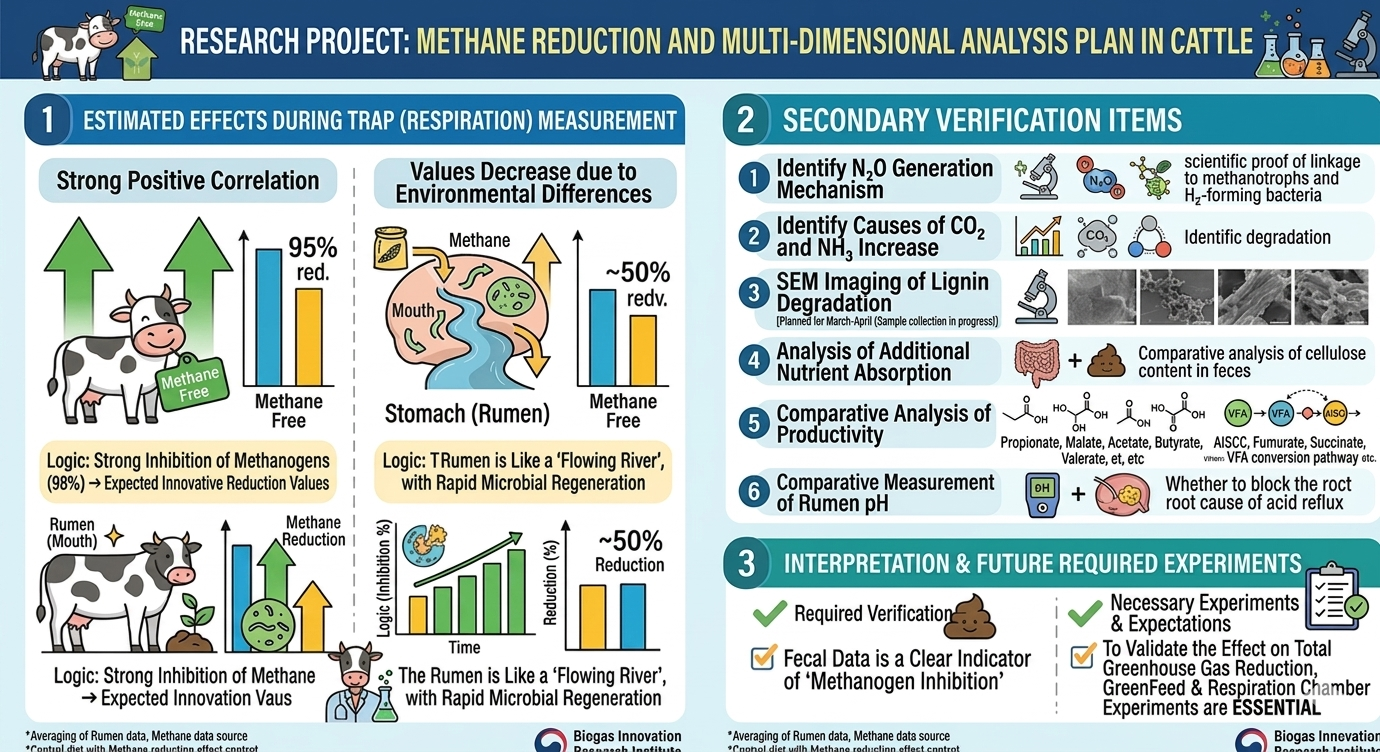
Research project — multi-dimensional analysis plan for bovine methane reduction
Ongoing validation — additional multi-dimensional analysis is being conducted, including N₂O measurement, SEM imaging of lignin degradation, and propionate / lactate / malate / fumarate quantification — expanding the evidence base.
Next: Independent In Vivo Validation

The definitive test is already designed.

Cornell University will evaluate TM0415 in 54 lactating Holstein dairy cows over 8 weeks, followed by whole-animal respiration-chamber measurement. We are publishing the protocol in advance — before the outcome is known. Confirmed to begin November 2026; methodology is being finalized and no results are available yet.

🇺🇸

Cornell University · Dairy Research & Education Center, Harford, NY

“Effects of dietary amorphous iron-sulfur cluster supplementation on enteric methane emissions, milk production, energy utilization, and the rumen microbiome in dairy cows.” Principal Investigator: Dr. Joseph McFadden. Randomized complete block design, three treatment arms, 18 cows per arm — followed by 48-hour respiration-chamber measurement at the Large Animal Research and Teaching Unit.

It measures where the energy goes — not just whether methane falls.

Suppressing methanogenesis is easy to claim; proving the spared hydrogen becomes milk instead of accumulating is not. Phase 2 closes the full energy balance by bomb calorimetry and C/N analysis on total collected feces, urine, feed, and milk — yielding digestible energy, methane energy loss, metabolizable energy, tissue energy retention, and milk energy output.

The mechanism is tested directly, not inferred.

Paired metagenomic and metatranscriptomic sequencing distinguishes which organisms are present from which are active — tracking methanogenic archaea, iron-reducing microorganisms, and propionate-producing bacteria against each other at baseline, week 4, and week 8.

The confounders are removed by design.

Diets contain no monensin, no yeast, and no yeast-derived additives, so nothing else in the ration can be credited with a methane or performance effect. Cows are blocked by energy-corrected milk yield and parity, and a 3-week covariate period gives every animal her own pre-treatment baseline.

Measured Metabolic Shift

The numbers behind 2× yield.

When electrons stop feeding methanogens, the entire rumen rewires itself — visible as a dramatic change in volatile fatty acid (VFA) ratios and net metabolizable energy. This is the chemistry of milk and weight gain.

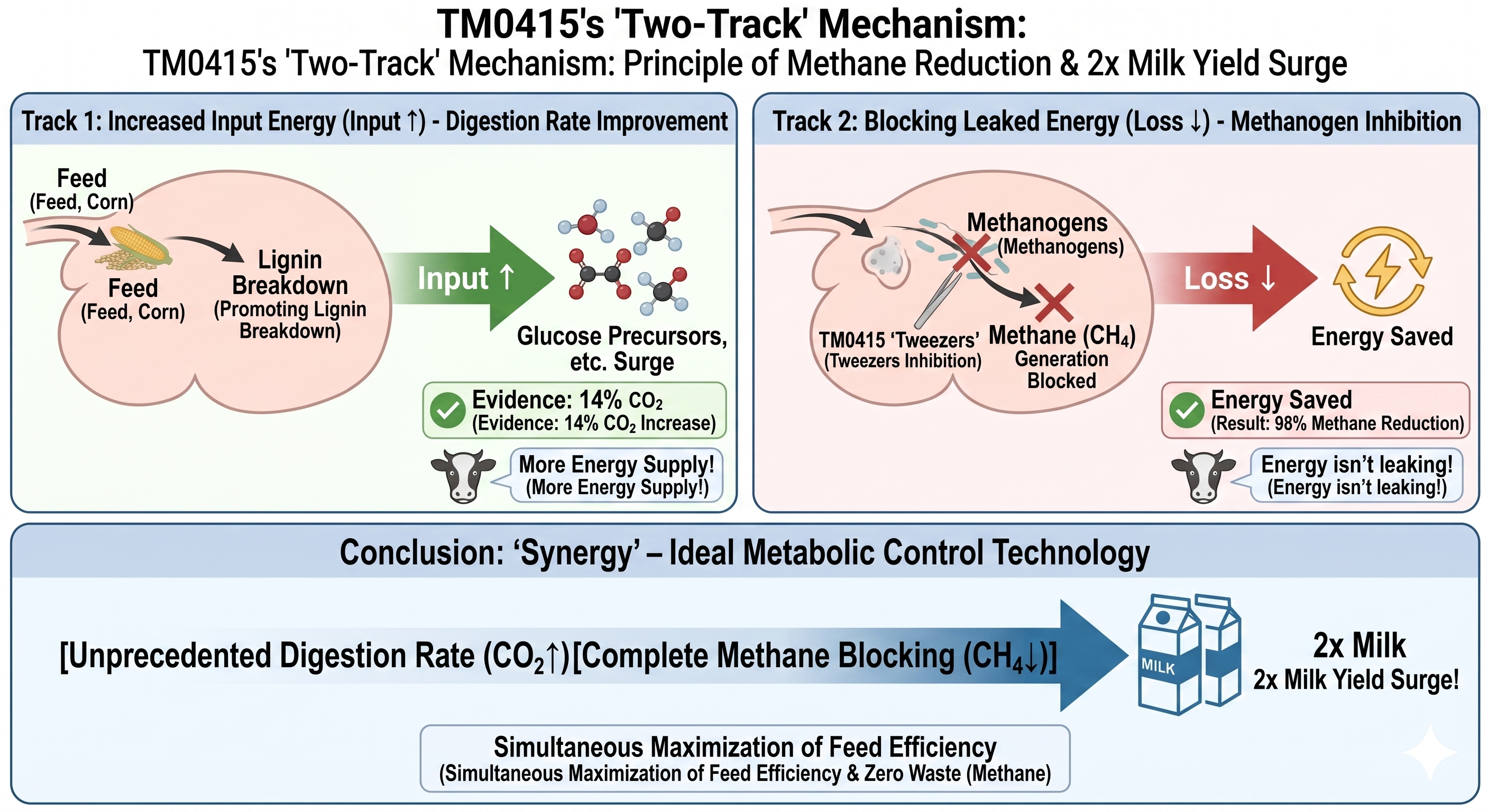
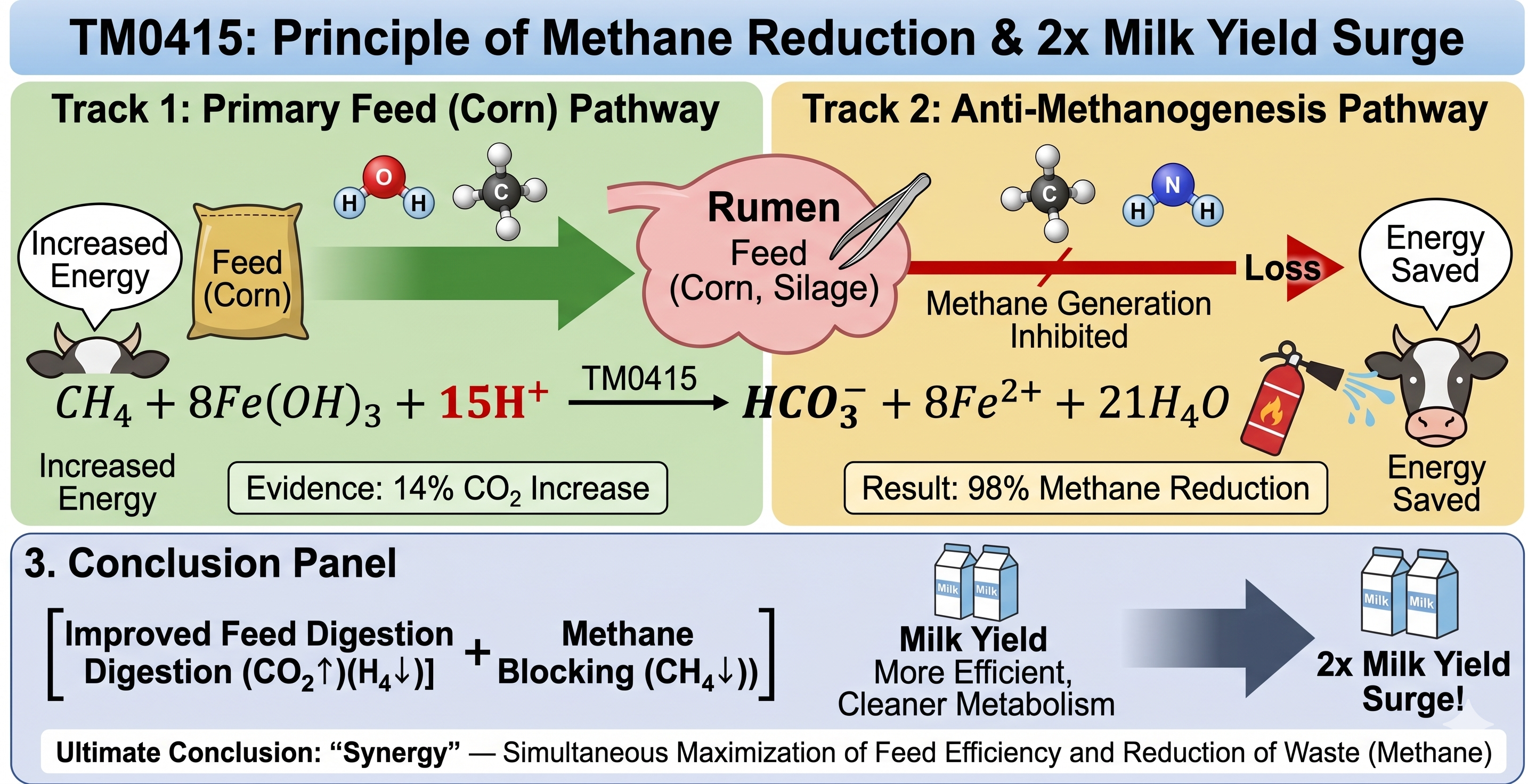
TM0415's Two-Track mechanism — principle of methane reduction and 2× milk yield surge
The Two-Track effect — Track 1: more energy in (lignin breakdown). Track 2: less energy out (methane blocked). Synergy delivers up to 2× yield.
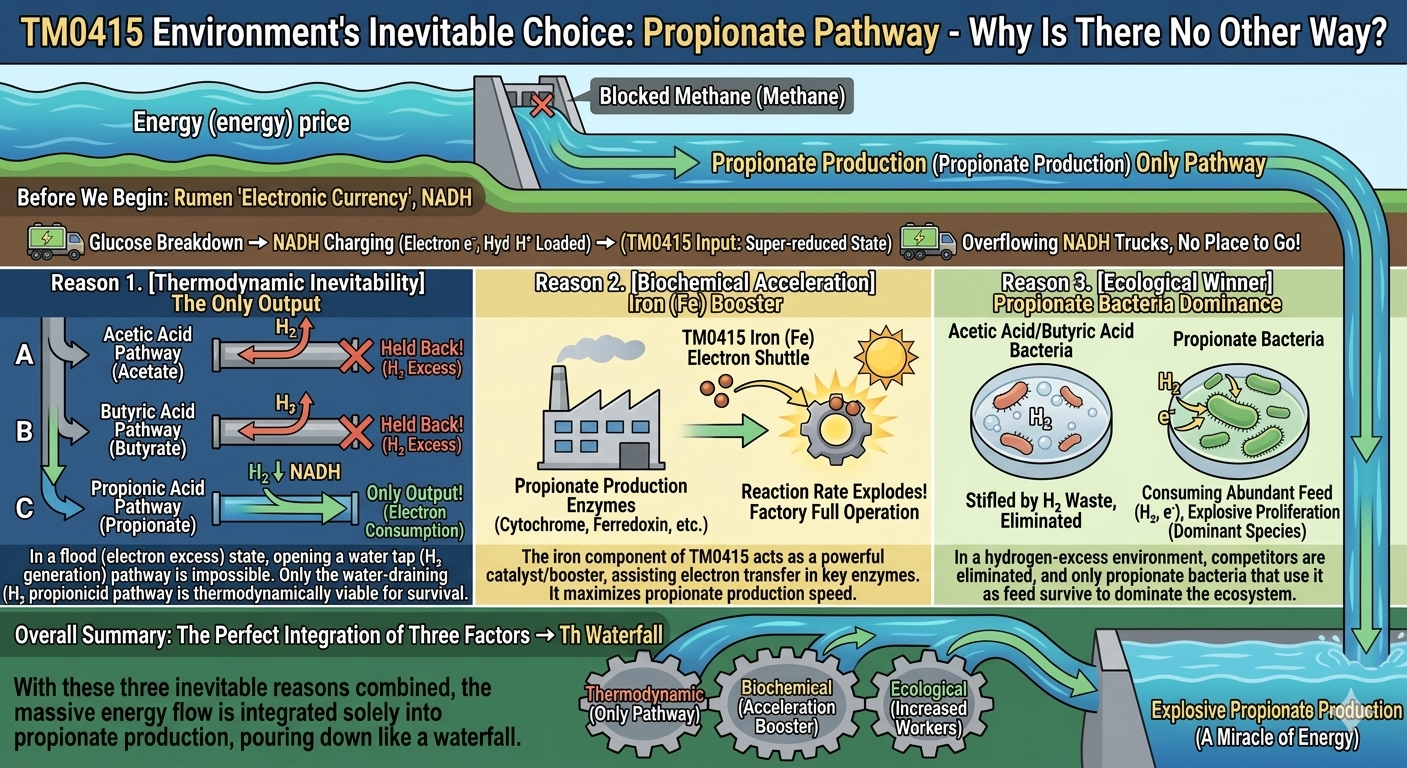
Why propionate is the inevitable pathway — three compounding factors
Why propionate is inevitable — thermodynamics, iron-catalyzed acceleration, and microbial ecosystem dominance all converge on propionate once TM0415 is active.

VFA rebalancing — before vs after

Propionate is the direct precursor to glucose in the ruminant liver. TM0415 shifts the rumen's energy output mix away from H₂-releasing acetate and toward energy-dense propionate.

Acetate
Control
65–70%
With TM0415
55–60%
↓ decrease
Propionate
Control
15–20%
With TM0415
30–35%
↑ ~2× surge
Butyrate
Control
10–12%
With TM0415
10–13%
→ stable
A : P ratio
Control3.5–4.5
With TM04152.0–2.5
Higher energy efficiency

Metabolizable energy amplification

Per kg of feed (GE indexed at 100), four compounding mechanisms push net energy available to the animal from ~55–60 up to 84–88.

+8 to +11
Methane loss prevented

Energy that normally vents as belches stays in the body.

+5 to +7
Lignin gradient boost

Steeper redox potential accelerates lignin breakdown — frees previously indigestible fiber.

+6 to +8
Propionate pathway conversion

Conserved hydrogen flows into the 3-carbon pathway — direct precursor for hepatic glucose.

+10 to +12
Mitochondrial ETC activation

Trace Fe–S clusters smooth electron transfer in Complex I–IV — maximizing ATP yield per glucose.

Net gain +28 to +29 points ≈ 30% more usable energy per kg of feed
Animal Welfare by Design

Eliminate methane. Eliminate five diseases.

Conventional methane inhibitors trap hydrogen — and trapped hydrogen is the root cause of nearly every metabolic disease in modern livestock. By routing electrons productively, TM0415 prevents the entire cascade at the source.

💨
Disease 01

Bloat

The "true" cause isn't gas — it's NADH stagnation forcing emergency lactate fermentation. The pH crash mucinates the rumen, traps gas as froth, and paralyzes the rumen wall.

TM0415 = Hydrogen sink → gas never accumulates
🧪
Disease 02

Acidosis (SARA)

Chronic subclinical acidosis from grain-heavy diets quietly destroys productivity. The proton sponge reaction (CH₄ + 8Fe(OH)₃ + 15H⁺ → HCO₃⁻ + 8Fe²⁺ + 21H₂O) restores pH.

Two defense lines: propionate replaces lactate + natural bicarbonate buffer
🥛
Disease 03

Ketosis

Post-calving dairy cows enter negative energy balance, mobilize body fat, generate ketone bodies. TM0415 supplies overwhelming propionate → hepatic glucose → no fat breakdown needed.

Anaplerosis: propionate refills the TCA cycle (oxaloacetate pool)
🦠
Disease 04

Diarrhea & Leaky Gut

Intestinal epithelial cells suffer the same electron stagnation as rumen microbes — tight junctions loosen, microbiome collapses, inflammatory exudation. TM0415 fuels ATP production in epithelial cells.

Tight junctions rebuild + microbiome rebalances
💊
Disease 05

AMR (Antibiotic Resistance)

~80% of livestock antibiotic use treats opportunistic infections from collapsed metabolism (liver abscesses, mastitis, metritis). Fix the metabolism, and antibiotic need plummets.

A One Health solution — global AMR crisis directly addressed
Bonus

Mitochondrial energy boost

Trace iron-sulfur clusters reach the animal's own mitochondria — lower electron-transport resistance in Complex I–IV, maximize ATP yield per glucose, suppress ROS oxidative stress.

Cellular welfare = production at peak efficiency
Acidosis prevention mechanism — chemical equation CH₄ + 8Fe(OH)₃ + 15H⁺ → HCO₃⁻ + 8Fe²⁺ + 21H₂O
The proton sponge chemistry — TM0415's iron-mediated reaction (CH₄ + 8Fe(OH)₃ + 15H⁺ → HCO₃⁻ + 8Fe²⁺ + 21H₂O) actively absorbs protons and generates natural bicarbonate buffer. Rumen pH self-regulates.
Engineering Moat

Why multinationals can't make this.

For decades, the world's leading research institutions — UC Davis, Cornell, CSIRO, Wageningen — knew iron-sulfur clusters were the theoretical holy grail. Nobody could make them work outside a cell. We solved four impossibilities at once.

CHALLENGE 01

The stability–activity paradox

Stabilize an Fe–S cluster against air, and you kill its catalytic activity. Make it active, and it oxidizes in minutes. We engineered a selectively permeable matrix: oxygen blocked, electrons through.

CHALLENGE 02

Amorphous → mass production

Crystalline metal clusters are easy to synthesize but catalytically inert. Amorphous structures are uniquely active but defy reproducible synthesis. Our proprietary process produces consistent amorphous geometry at industrial ton-scale.

CHALLENGE 03

Surviving feed processing

Pellet extrusion runs at 80°C+ under high pressure. Microbial additives suffer >99% mortality. TM0415's mineral-cluster armor survives intact through industrial blending, pelletization, and TMF fermentation.

CHALLENGE 04

Reverse-engineering immunity

The secret isn't in the molecule — it's in the manufacturing process. Reverse-engineering a finished cluster won't reveal which biological process, temperature curve, or stabilization sequence produced it. A black-box moat.

"We had the map, but no car to drive."

For 40+ years, ruminant nutritionists at the world's top research universities defined the criteria for the "ideal electron acceptor" — a substance with higher redox potential than methanogens, no toxic intermediates, propionate redirection, and infinite catalytic activity at trace concentrations.

Every one of those four criteria pointed at iron-sulfur clusters. None of them could engineer stability. TM0415 is the realization of a forty-year scientific quest — and the only product on Earth that meets all four.

— Referenced research: Dr. Ermias Kebreab (UC Davis), Dr. Alexander Hristov (Penn State), Dr. Stuart Denman (CSIRO)

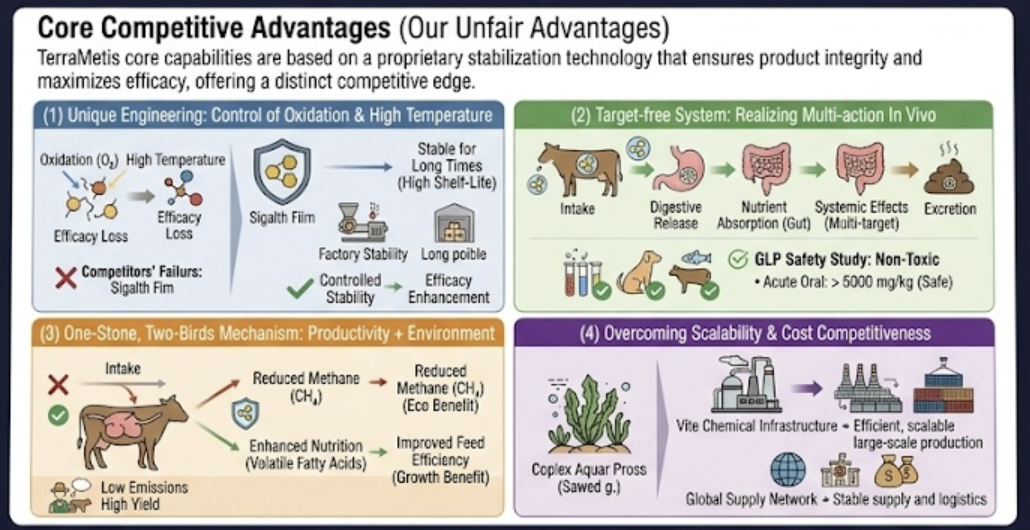
Core Competitive Advantages (Our Unfair Advantages)

TerraMetis's core capabilities are built on a proprietary stabilization technology that may help maintain product integrity and could maximize efficacy — together suggesting a distinct competitive edge.

01Unique Engineering: Control of Oxidation & High Temperature

  • Stabilization technology may protect the cluster from oxidation and light degradation
  • Pellet & flake process-stable at 80 °C+ industrial conditions
  • Long shelf-life through proprietary matrix encapsulation
  • Competitors' failures: conventional Fe-S compounds typically lose efficacy on air contact within minutes
✓ Our breakthrough: stabilized TM0415 (AISC) usable in real-world feed processing

02Target-free System: Multi-action in vivo

  • Intake → digestive release → nutrient absorption → systemic effects → excretion
  • Acts across the entire ruminant biology — not bound to a single enzyme or microbe
  • GLP acute oral toxicity: > 5,000 mg/kg (non-toxic)
  • GLP 13-week repeated-dose oral toxicity: > 1,000 mg/kg (non-toxic)
✓ Both exceed toxicology test limit dose (Non-toxic per EPA criteria)

03One-Stone, Two-Birds: Productivity + Environment

  • Reduced methane (CH₄) — environmental benefit
  • Enhanced nutrition via redirected volatile fatty acids (propionate pathway)
  • Improved feed efficiency — productivity benefit
  • Energy that would have vented as methane may be recovered as ATP and growth
✓ Low emissions × high yield — no trade-off

04Overcoming Scalability & Cost Competitiveness

  • Unlike seaweed-derived approaches, no complex cultivation required
  • Inorganic chemistry infrastructure → efficient, scalable, large-scale production
  • Global supply network + stable supply and logistics
  • Mass-producibility at industrial ton-scale
✓ Supports premium price competitiveness vs existing alternatives
The four unfair advantages — engineered stability, target-free multi-action in vivo, the combined mechanism for productivity and environment, and unmatched scalability with cost competitiveness.
Core Competitive Advantages (Our Unfair Advantages) — four-quadrant infographic: (1) unique engineering controlling oxidation and high temperature, (2) target-free multi-action in vivo with GLP non-toxic safety, (3) one-stone two-birds mechanism for productivity and environment, (4) overcoming scalability and cost competitiveness.
Core Competitive Advantages — TerraMetis's proprietary stabilization technology delivers a distinct, defensible edge across all four pillars.
Win-Win-Win Flywheel

No subsidies needed. Just better economics.

Most "climate tech" depends on government subsidies and stops the moment the money does. TM0415 is the rare innovation where farmers, corporations, and governments all profit simultaneously — making adoption self-sustaining.

⟶ Farmer

2× milk yield buys itself.

No environmental guilt-trip required. Farmers adopt TM0415 because doubled milk output and 35–40% lower feed costs make the math obvious. Voluntary adoption at scale — the strongest dissemination engine of all.

Profit-driven adoption
⟶ Company & Investor

Dual revenue streams.

Feed/raw material sales as steady cash flow, plus premium methane carbon credits as the megatrend upside. Black-box manufacturing locks in monopolistic margins. A platform play for global capital markets.

10× valuation logic
⟶ Government

NDC achieved — without subsidies.

Private sector hits the Global Methane Pledge target while paying for itself. Government just needs to certify the carbon credits and let the market work. The ideal policy stance.

Zero budget exposure
The Mega Market

Three giant markets — one product at the intersection.

TM0415 doesn't fit a single category. It simultaneously addresses the global feed additive market, the voluntary carbon credit market, and the Scope 3 supply-chain defense problem of the world's largest food brands. That's a platform business.

Market 01 · Real Economy
~$40B
Global feed-additive market by 2030

B2B to feed mills & co-ops

1.5 billion ruminants worldwide. Farmers adopt for productivity, not regulation. Our revenue: raw material supply, TMF manufacturing, formulation licensing royalties.

Market 02 · Climate Finance
~$50B
Voluntary Carbon Market by 2030 (McKinsey)

Premium methane credits

Methane reduction carries an 80× warming-prevention premium. ~1.5 tCO₂eq reduced per head per year. Across 500K head, that's $7.5M/yr today — projected to reach $60M/yr at 2030 carbon prices.

Market 03 · Scope 3 Defense
F&B brand market caps at stake

Nestlé · McDonald's · Starbucks

Without methane mitigation, global F&B brands cannot hit their public Net-Zero targets — and face supplier carbon taxes, ESG divestment, consumer backlash. TM0415 is the only Scope 3 solution farms voluntarily adopt.

Leadership

Built by operators with conviction.

TerraMetis is led by a team pairing deep scientific conviction with a proven record of taking complex products from bench to global commercial scale.

TO

Teresa Oh

Founder & CEO

Teresa leads the strategic vision of TerraMetis. A graduate of George Washington University and Tufts University School of Dental Medicine, she built a successful clinical practice before being captivated by the scientific potential of amorphous iron-sulfur cluster chemistry — and by the climate-scale problem it could solve in agriculture.

Driven by this conviction, she made the decisive move to transition from clinical practice to biotechnology, investing her personal assets to commercialize the technology as TM0415. As a tenacious entrepreneur, Teresa is now dedicating her full efforts to evolving TerraMetis from a pioneering climate-tech firm into the global standard in livestock methane mitigation.

Her leadership is defined by a unique fusion of clinical insight from her medical career and a proven ability in corporate scaling and strategic partnerships.

Strategy & Vision Scientific Conviction Clinical Background Capital Formation
ED

Eric Denbow

Chief Operating Officer

Eric leads operations and commercial strategy at TerraMetis. A Cornell University graduate (B.S., Applied Economics & Management), he brings deep experience leading complex strategic engagements at Ipsos, where he managed $6.5M+ in research programs for Fortune 500 healthcare clients across U.S. and international markets.

His expertise spans the full project lifecycle — from study design and quantitative analysis to executive-level readouts — combined with a proven record of mentoring and scaling cross-functional teams. At TerraMetis, Eric translates customer insight into go-to-market execution, building the partnership infrastructure required to scale TM0415 to feed mills, livestock operators, and climate partners worldwide.

Operations Commercial Strategy Market Research Team Leadership Fortune 500 Clients
J

Jonathan Um

Chief Financial Officer

Jonathan serves as Chief Financial Officer at TerraMetis, where he leads the company's financial strategy, capital planning, and operational finance to support commercialization and long-term growth. A graduate of New York University with a bachelor's in Economics, he brings a strong foundation in financial analysis and strategic planning, with experience evaluating complex transactions, underwriting investments, and driving data-informed decision-making in dynamic markets.

His expertise spans financial modeling, capital allocation, forecasting, and investment analysis, combined with a disciplined approach to operational execution and long-term value creation. At TerraMetis, Jonathan oversees financial planning, budgeting, investor readiness, and corporate finance initiatives while partnering closely with the executive team to align financial strategy with commercial expansion. He plays a key role in building the financial infrastructure required to scale TM0415 across feed mills, livestock producers, and global climate markets.

Financial Strategy Capital Planning Investor Readiness Capital Allocation Investment Analysis
Common Questions

For investors, partners & technical reviewers.

We've compiled 18 in-depth questions covering mechanism, manufacturing, safety, animal welfare, market, and competitive comparison. A small sample below — the full Q&A is on a dedicated page.

How does TM0415 differ from chemical electron-sink reducers (nitrate, sulfate) at the mechanism level?

Nitrate and sulfate are fixed-potential consumables — when they absorb electrons, their molecular form changes and the new forms are precisely the toxic species (nitrite NO₂⁻, hydrogen sulfide H₂S) that may cause methemoglobinemia or PEM neural death. They cannot be recycled and must be excreted. TM0415 is a variable-potential biocatalyst — it accepts electrons and hands them off to the propionate pathway without itself being consumed or transformed. The cluster cycles indefinitely. Even at 1.2 ppm catalytic dose, it may achieve superior efficacy with no toxicity.

Why is the engineering "moat" so hard for multinationals to replicate?

Natural iron-sulfur compounds oxidize within minutes of air exposure. Conventional chemical synthesis can stabilize a crystalline cluster — but kills its catalytic activity. The reverse is also true. Solving the stability–activity paradox required a proprietary biological-mineral hybrid process. The secret isn't in the molecule — it's in the manufacturing pathway, which can't be reverse-engineered from a finished sample.

Why don't nitrate or sulfate solutions work — they also accept electrons?

They do, but with fatal byproducts. Nitrate (NO₃⁻) reduces to nitrite (NO₂⁻), which oxidizes hemoglobin to methemoglobin — cattle suffocate from internal asphyxia. Sulfate (SO₄²⁻) reduces to hydrogen sulfide (H₂S), which causes polioencephalomalacia (cortical neural death). TM0415 redirects electrons into pyruvate → propionate — a physiologically safe pathway the animal already uses.

What's the regulatory path?

GLP acute oral toxicity testing has cleared TM0415 at doses >5,000 mg/kg and 13-week repeated-dose oral toxicity testing at >1,000 mg/kg — both exceeding the toxicology test limit dose (Non-toxic per EPA criteria). Field deployment has begun under Kenya–Korea bilateral programs (KOICA/KALRO) as reference-level data; definitive validation is pending US-based in vivo trials. Major-market registrations are being pursued in parallel with global B2B engagement.

Partner With Us

Let's run a pilot.

Whether you represent a feed mill, dairy cooperative, livestock operator, climate fund, F&B brand managing Scope 3 risk, or research institution — we'd like to hear how TM0415 fits your operation.

Partnerships & inquirieshello@terrametis.io
HeadquartersPittsburgh, Pennsylvania, United States
Open toFeed mills · Dairy & beef operators · Global F&B brands · Climate funds · Research partners

We respect your privacy. Your information is never shared with third parties.

Important Disclosures
A.

Portions of the content on this website may include results derived in part from AI-assisted simulation.

B.

Detailed information on the amorphous iron-sulfur cluster (TM0415) is considered a trade secret and has been minimized accordingly.

C.

The Kenya KALRO field results are reference-level data, not definitive. Only US-based in vivo trial results — once completed — will constitute confirmed, citation-grade evidence.

D.

The redox potential of the amorphous iron-sulfur cluster is variable, depending on electron and pH environment. This may act as a gyroscope-like balance for rumen pH, potentially suppressing acidosis — even when grain feed is increased 2× or more, no problems may be observed.